If you garden where deer are plentiful, you already know that sooner or later, they are going to eat some of your plants.
Over the years, I’ve found that rather than trying to protect everything, it can be helpful to think a little more strategically about what I plant and where I plant it.
I use a combination of plants the deer enjoy and plants they tend to avoid. The idea is simple: give them something I’m willing to share, while making some of the plants I’d rather protect a little less inviting.
Give Them Something You’re Willing to Share
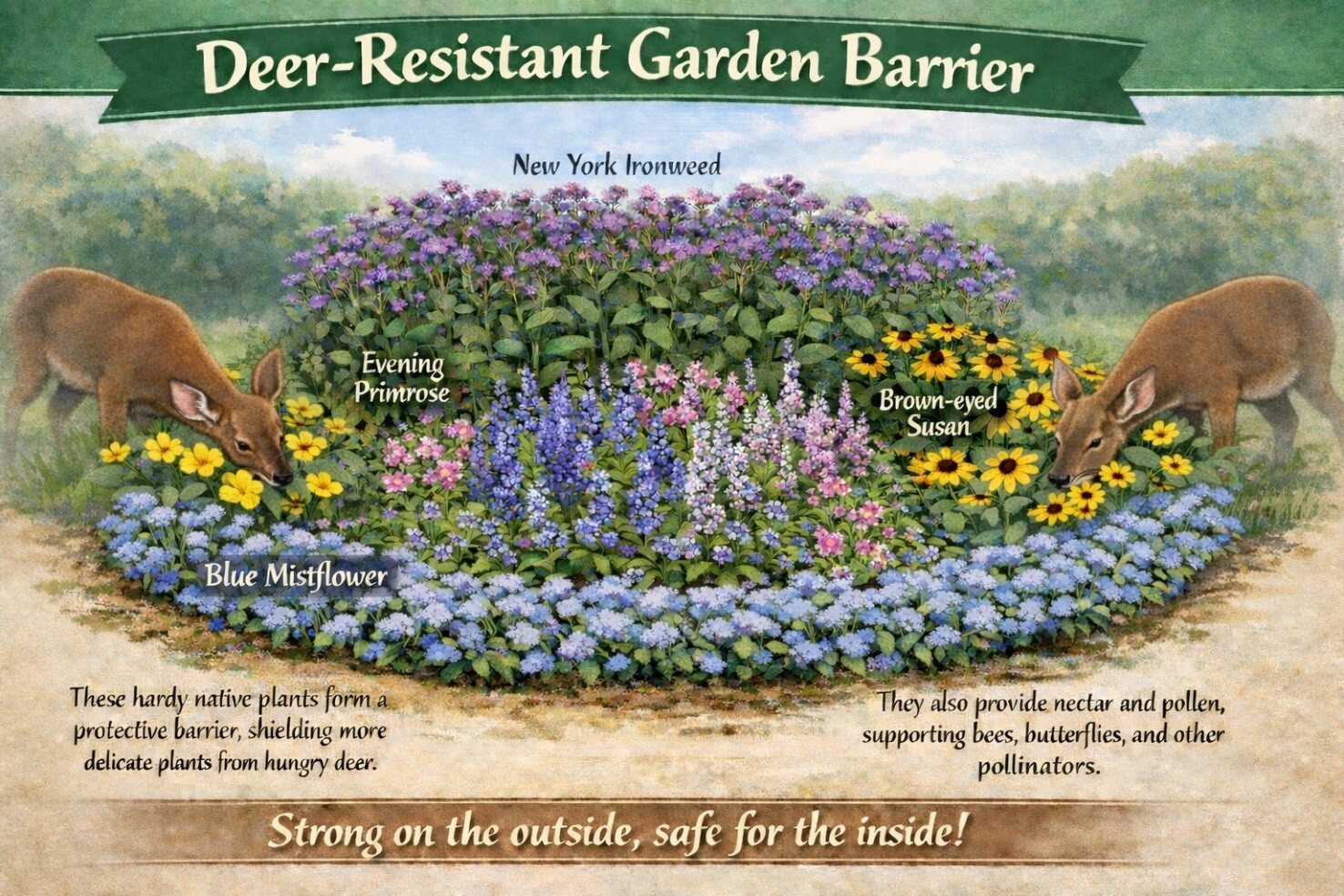
Evening primrose (Oenothera biennis), tall goldenrod (Solidago altissima), and brown-eyed Susan (Rudbeckia triloba) are three plants I don’t mind sharing with the deer.
All three are vigorous enough to tolerate browsing and continue growing and blooming. I like planting them in areas where I know the deer regularly travel, including along some of their established paths through the property.
There’s another advantage, too. These plants can get quite tall, sometimes taller than I really want in certain parts of the garden.
Many gardeners use what’s known as a “Chelsea chop,” cutting taller plants back earlier in the growing season to encourage shorter, bushier growth. Around here, the deer often take care of that job for me.
When they browse the tops, the plants tend to branch out, stay shorter, and still produce plenty of flowers. The deer get something to eat, the plants recover, and I end up with a more manageable plant without having to prune it myself.
That’s a pretty good trade.
Protect the Other Side of the Garden
The other half of the strategy is using plants deer tend to avoid around plants I’d really rather they didn’t eat.
Strongly scented plants can be particularly useful. I like to use native mints and other aromatic plants to create what I think of as a “mint blockade.”
Blue mistflower (Conoclinium coelestinum) is one plant I use this way. By planting it generously around or in front of more vulnerable plants, I can make those areas of the garden less appealing to browsing deer.
It isn’t a fence, and it certainly isn’t a guarantee. A hungry deer can always surprise you. But I’ve found that combining these less appealing plants with plenty of browse-tolerant plants elsewhere can help steer some of that feeding pressure in a direction I’m more comfortable with.
A Little Attraction, A Little Deterrence
That’s really the whole idea.
In one part of the garden, I’m planting vigorous natives that the deer can browse without doing much harm. In another, I’m using plants they tend to avoid to help protect things I’d rather keep off the menu.
And when they do browse the plants I’ve offered them, sometimes they’re actually doing a little garden maintenance for me.
A chewed evening primrose, tall goldenrod, or brown-eyed Susan isn’t necessarily a lost plant. It may simply have received a free Chelsea chop.
Of course, there are still plants I protect, and no planting strategy is going to make a garden completely deer-proof. But I’ve found that giving the deer something I’m willing to share, while making other areas less inviting, can make living with them a little easier.
The deer get something to eat, some of my favorite plants get a little protection, the taller plants stay at a more manageable height, and I have a little less pruning to do.
I’d call that a win-win.