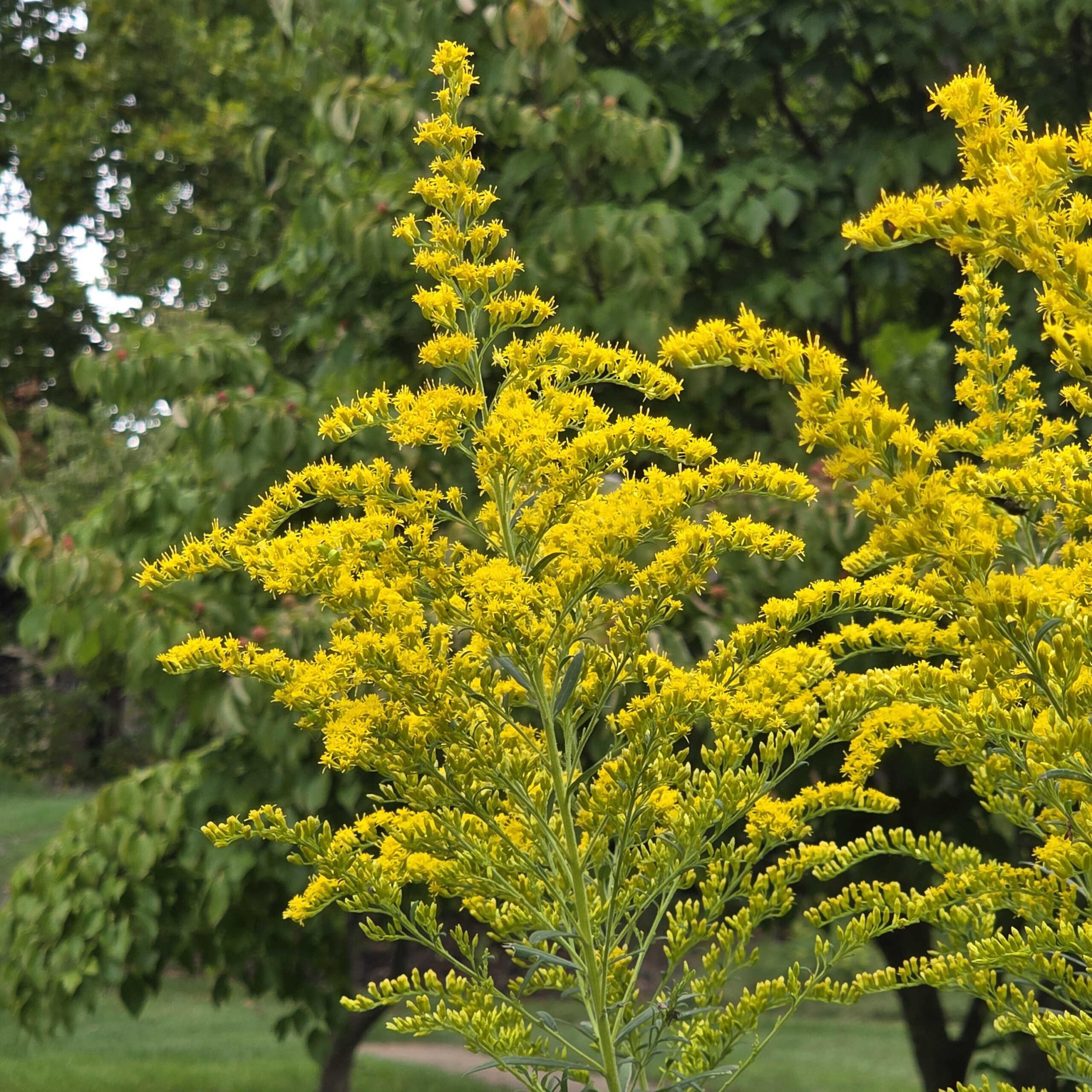
Right now, goldenrods are lighting up the gardens at Stover Mill Farm, and one of the things we love about them is just how different they can be.
Goldenrod sometimes gets a reputation for being a little unruly, but there are many species to choose from, and they don’t all behave the same way. Some stay fairly compact and polite, while others are perfectly happy to claim a little more territory.
White Goldenrod, or Silverrod (Solidago bicolor) is the oddball of the group, and one of our favorites. Instead of the familiar bright yellow flowers, its upright stems are lined with small creamy-white blooms. It has a relatively restrained growth habit and doesn’t race through the garden, making it a nice choice when you want goldenrod’s wildlife value without a lot of spreading.

Gray Goldenrod (Solidago nemoralis) is another well-behaved choice. It stays shorter than many goldenrods and works especially well in sunny, drier areas. It tends to form manageable clumps rather than taking over, so it can fit nicely into a more traditional garden bed.

Blue-stemmed Goldenrod (Solidago caesia) has a completely different look. Its arching, often bluish stems carry little clusters of yellow flowers along their length. It is also relatively well behaved and is especially useful because it can handle part shade, even woodland-edge conditions where many goldenrods aren’t as happy.

And then there’s Tall Goldenrod (Solidago altissima) (pictured above). Tall goldenrod is beautiful, valuable to wildlife, and definitely more enthusiastic. It can grow quite tall and spread readily by underground rhizomes, which makes it wonderful for naturalized areas, meadows, and places where it has room to move. In a garden bed, it may need a little guidance.
One easy way to manage its height is a Chelsea chop, cutting the stems back by roughly one-third to one-half in late spring or early summer. The plants respond by growing shorter and bushier, often with more branching and flowers, rather than towering over their neighbors.
The lesson? There really is a goldenrod for almost every garden.
If you want something shorter and restrained, there are goldenrods for that. If you have a woodland edge, there’s a goldenrod for that. And if you have a big space where a plant can spread, there’s definitely a goldenrod for that, too.
And right now, they’re earning their keep. Goldenrods are among our most important late-season native plants, providing nectar and pollen when many summer flowers are beginning to fade.
So if you’ve always thought of goldenrod as that big yellow plant along the roadside, take another look.