My philosophy for handling aggressive native plants is actually a lot like a principle found in martial arts.
Instead of meeting force with force, you redirect that energy and use it to your advantage.
That’s pretty much how I garden.
When I have a native plant that wants to spread, my first instinct is always:
“How can I use what this plant naturally wants to do to my advantage?”
Golden Ragwort (Packera aurea) wants to form a dense colony? I use it as a living groundcover that helps keep weeds out.
Wild Strawberry (Fragaria virginiana) wants to send runners everywhere? I give it an area where I’d much rather have strawberries covering the soil than weeds or grass.
Mountain Mint (Pycnanthemum spp.) wants to spread sideways? Give it some room and that spreading habit can become a beautiful mass of flowers buzzing with pollinators.
Sometimes I even want my natives to be aggressive enough to compete with the plants I don’t want there. If I’ve got a choice between constantly fighting weeds and letting a vigorous native occupy that space, I’ll put the native plant’s enthusiasm to work.
Although I have to admit, I’d kind of like to see Japanese stiltgrass and pokeweed go toe to toe.
Give Them Boundaries When You Need Them
Of course, there are places where I really don’t want a plant to spread. But that doesn’t mean I have to spend the rest of my life pulling it.
Golden Ragwort, Wild Strawberry, Wild Basil, and other spreaders can go into beds surrounded by sidewalks or other hard surfaces. They’re free to fill the space, but the hardscape gives them a natural stopping point.
For smaller areas, a container can accomplish the same thing.
Instead of constantly fighting the way the plant naturally grows, I let the boundaries do the work.
Sometimes the Location Does the Controlling
Physical barriers aren’t the only option.
Obedient Plant (Physostegia virginiana) can spread rapidly when you give it conditions it loves. But I’ve found that when I put it in a shadier location, it behaves very differently.
I still get a beautiful plant and flowers, but without nearly as much spread.
Sometimes I don’t need to physically contain an assertive plant. I can simply choose a location where it will be happy without being quite so enthusiastic.
Let One Plant Become the Backdrop for Another
And sometimes I don’t want to contain it at all.
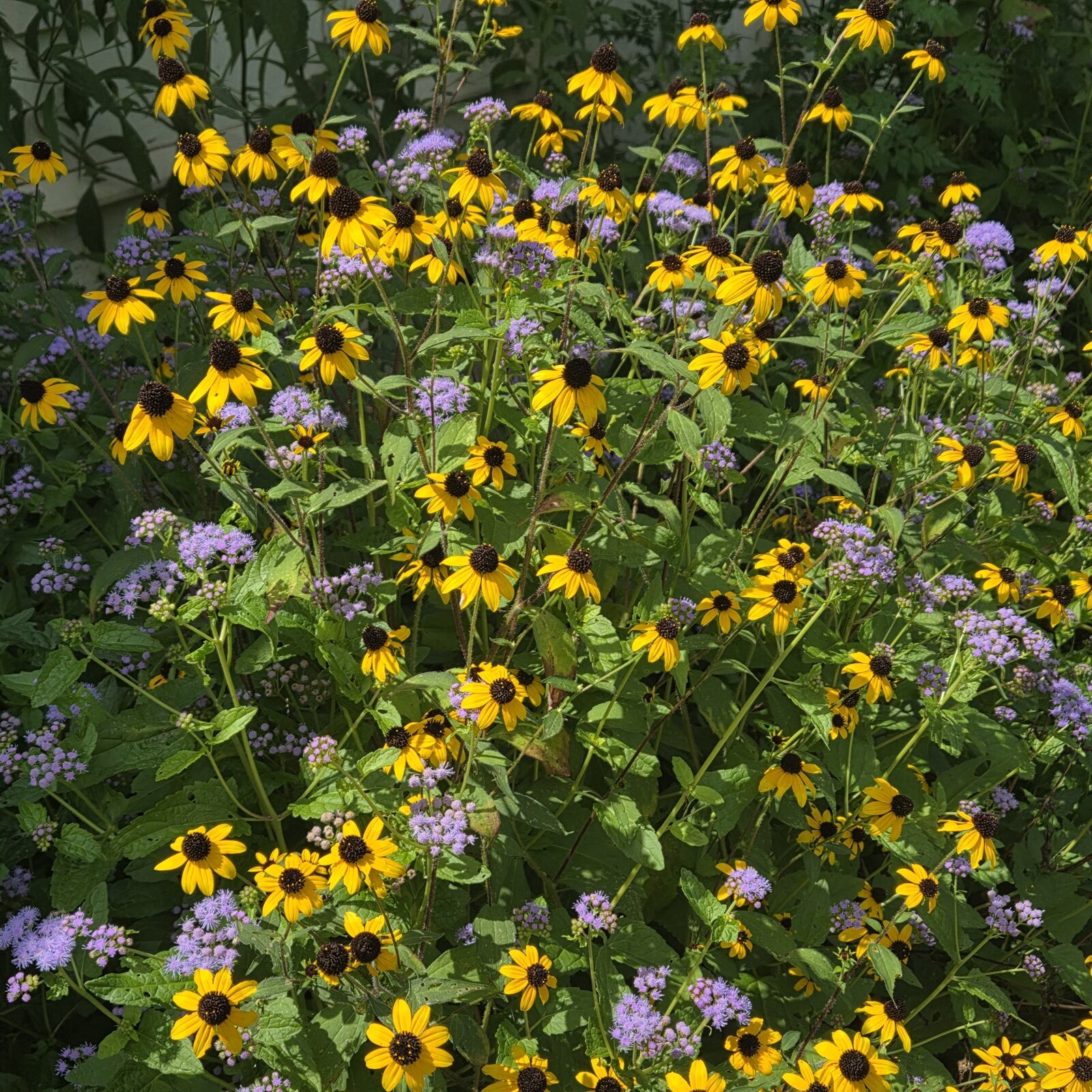
Blue Mistflower (Conoclinium coelestinum) can take over just about everything when it’s happy.
But a large patch of those soft lilac-blue flowers can also be absolutely beautiful, especially when I stop thinking of it as an individual plant and start treating it as a backdrop.
Imagine a bright red Cardinal Flower (Lobelia cardinalis) popping up through all that lilac. Or the yellows of Brown-eyed Susans (Rudbeckia triloba) and pinks of Spotted Beebalm (Monarda punctata) scattered through it.
Blue Mistflower fills the spaces between them while allowing those taller plants to come through, even lending a little support to plants like Cardinal Flower when they get top-heavy.
Instead of fighting that sea of Blue Mistflower, I use it as part of the design.
And Then There Are the Seeders
Some assertive natives don’t travel primarily through runners or rhizomes. They’re simply very, very good at making more plants.
Those give me another opportunity.
If I want more plants, I let them go to seed.
If I don’t want more plants in that particular spot, I can collect the seed before it spreads and use it somewhere I do want more plants.
Maybe that’s another garden. Maybe it’s an area I’m trying to naturalize. Maybe it’s the beginning of a meadow.
Once again, I’m redirecting instead of fighting.
Have a Lot of Ground to Cover? Set Them Free.
Have an acre you’re trying to establish as a native meadow?
This is exactly where I want plants like Wingstem (Verbesina alternifolia), Blue Mistflower, Carolina Elephant’s-foot (Elephantopus carolinianus), Purpletop (Tridens flavus), and other natives that are really good at making more of themselves.
In a small garden, spreading three feet might feel aggressive.
In an acre you’re trying to restore, that’s progress.
Have an Eroding Slope? That’s Another Opportunity.
Some of these enthusiastic natives are also great plants to consider for a slope or bank where you need roots in the ground holding onto the soil.
Native grasses such as Switchgrass (Panicum virgatum), Purpletop, Little Bluestem (Schizachyrium scoparium), and Indiangrass (Sorghastrum nutans) develop extensive root systems that can help stabilize soil. Spreading plants such as Golden Ragwort and Mountain Mint can help cover the ground, too. Even the colony-forming habit of Winged Sumac (Rhus copallinum) can become an advantage on the right bank or hillside.
For serious erosion or fast-moving water, plants alone may not be enough. But for an ordinary slope where you need plants to establish and hold the soil, this can be one more place to put some of our enthusiastic natives to work.
It’s All About Putting the Behavior to Work
The technique changes depending on the plant, but the philosophy stays the same.
I don’t want to spend my time fighting a native plant for doing exactly what it evolved to do.
I want to understand that behavior and put it to work.
A spreading plant can suppress weeds.
A prolific seeder can help establish a meadow.
A colony-forming plant can become a beautiful backdrop for other flowers.
Deep, spreading roots can help stabilize a slope.
And sometimes an enthusiastic plant simply needs a sidewalk to tell it where to stop.
So when someone tells me a native plant is “too aggressive,” my first question isn’t necessarily how to stop it.
It’s:
“Where can I put this plant so its aggressiveness becomes an advantage?”
That’s how I use the plant’s natural behavior to accomplish what I wanted in the garden anyway.
To see more of what weu{2019}re growing, learning, and discovering around the farm, follow us on Stover Mill Farm on Facebook.